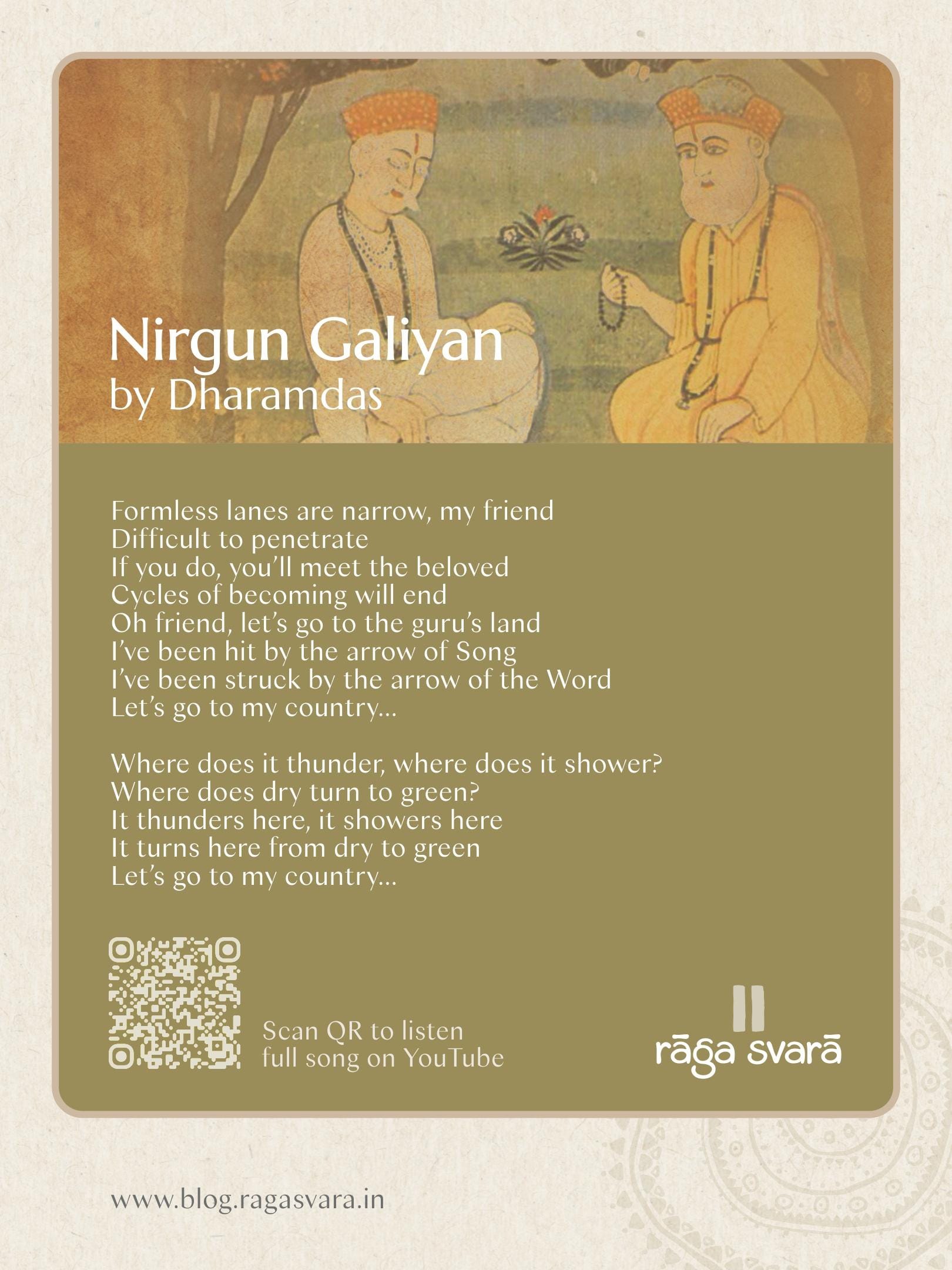
Interpretation of the Bhajan Nirgun Galiyan by Dharamdas
We often feel lost. Unable to express ourselves. We try many different ways. We discover and even create the worlds we live in through our interaction with symbols such as paintings, sculptures, music, dance and other forms of art and expression. At Raga, a core element of well-being is the ability to pause, see and reflect on art and aesthetics. To think and feel deeply about art.
Some songs are more than a piece of music. They feel like revelations, like invitations into a transcendental or spiritual space we usually forget exists beneath the noise of everyday life. A space where you feel deeply connected to yourself or maybe, where you truly see yourself. The purpose of such songs is not entertainment, they pull you inward.
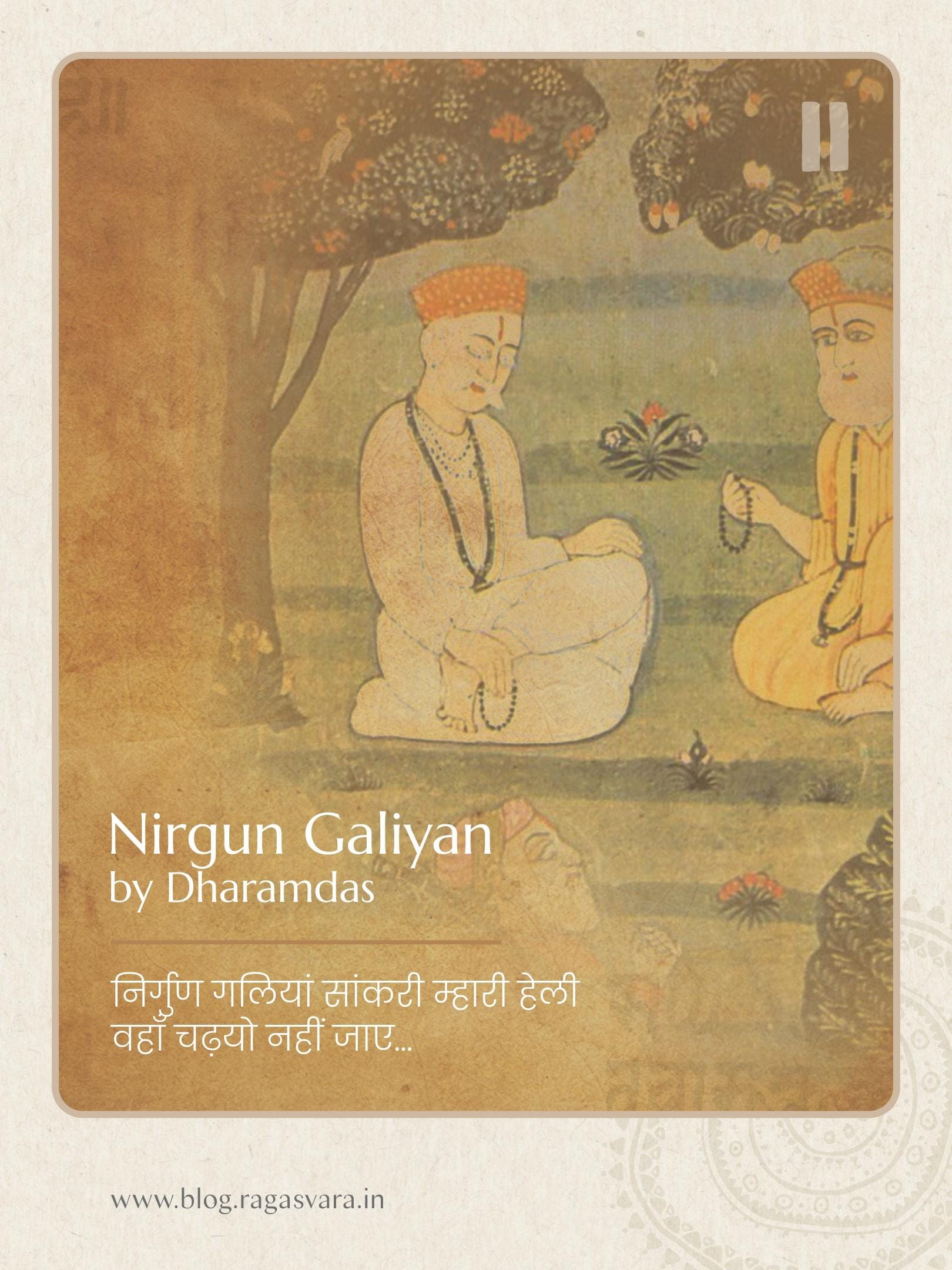
“Nirgun Galiyan” feels like one of those songs, something to sit with and listen to what's being said. It is a bhajan written by Dharamdas, a disciple of the great poet and saint Kabir Das. In the bhajan, Dharamdas speaks about all that his guru taught him and reveals the idea of a state of being that exists beyond the worldly Bhanwar, the endless whirlwind of attachment, ego, desire and chaos that keeps people trapped within themselves.
Nirgun galiyan saankari, mhari heli
Wahan chadhyo nahi jaaye
Wahan chadhe to piya mile, mhari heli
Aavagaman mit jaaye
Mhari heliye, chalo hamara des.
The song speaks about “nirgun” something beyond form and labels. The path towards it is described as “saankari” narrow. Not physically, but narrow because a person cannot walk it carrying pride, greed, anger, attachment or the constant need to prove themselves. That is why Dharamdas says, “wahan chadhyo nahi jaaye.” It's not easy to walk on this path. But if someone does, they meet their “piya.” Here, “piya” is not just a lover. It is the truth or the Divine, the real self hidden behind worldly identity. And once that meeting happens, “aavagaman mit jaaye” the endless cycle of searching, suffering, craving, becoming, and losing, and the cycle of birth, death, and rebirth, comes to an end. The song keeps repeating, “chalo hamara des,” as if calling the listener back to their original home, not a physical place, but a state where the soul is free from illusion.
Kahan uge, kahan aaste
Mhari heli, kahan ujala hoye
Yahin uge, yahin aaste, mhari heli
Yahin ujala hoye
Mhari heliye, chalo hamara des
Yon to yahi ujala hoye
Mhari heliye, chalo hamara des.
In the above lines it feels like someone is searching for light or truth outside, asking where the truth rises, where it rests or peace exists, “kahan ujala hoye?” And the answer comes back “yahin,” right here. Light is not somewhere far away, peace is not waiting in another world, another city, another person or another life. It's already there, within. The same place where darkness exists is also where light can exist. It points to the point that what you are searching for is already around you and within you you just have to see it, realise it.
Kahaan ko garje, kahaan barse, mhari heli
Kahaan sukha ka hariya hoe
Yahin garje, yahin barse, mhari heli
Yahin sukha ka hariya hoe
Mhari heli vo, chalo hamara des
Yon to lagya bhajan wala baan
Mhari heli vo, chalo hamara des
Then the song asks where the rain falls that can turn dryness(sookha) into green again. The “sookha” is the miserable state of being, sadness, dullness, an exhausted mind or life. Again the answer is “yahin.” Right here. The storm, the suffering, the rain, healing all happen within this life, this body, the human existence. Nothing comes from the outside to fix it, this transformation takes place right here. Then comes “bhajan wala baan” as if devotion, music or yearning for truth have pierced the heart like an arrow to awaken someone and guide them towards their real home.
Nirgun ka bazaar mein, mhari heli
Heero ko hove vyapaar
Sugura maanav to saudo kare, mhari heli
Ee to nugura mool gavaaye
Mhari heli vo, chalo hamara des.
One of the verses speaks about “nirgun ka bazaar.” It gives an impression of a place where only diamonds are traded. But not everyone recognises a diamond. “Sugura maanav” the wise person, understands the value of truth and knows what is worth exchanging their life for. The ignorant person loses the real treasure while running after temporary things. The writer critiques the way people spend their lives chasing image, wealth, power and ego while remaining disconnected from themselves.
Anhad ka maidan mein, mhari heli
Mhara sahib ji ki sej
Haan, kahe Kabir Dharmdas se, mhari heli
‘Na to mare, na boodha hoe’
Mhari heli vo, chalo hamara des.
The final section reaches “anhad ka maidan” , a space beyond the physical world. In Kabir’s poetry, “anhad” is often mentioned, it is the eternal inner sound of existence, something that cannot be heard with the ears, only felt deeply. And there lies “mhara sahib ji ki sej” the resting place of the divine, the “piya”, the true self, it is the place, the “des” of complete surrender, union and peace. Where one reaches by walking on the “Nirgun Galiyan”. Then Kabir says, “na to mare, na boodha hoye” perhaps he meant to say that one comes to the realisation that the truth and soul do not age and do not die. The soul, the real self is eternal and what is eternal exists beyond time and decay. This part feels deeply freeing as if after all the wandering, searching, suffering and learning, one finally reaches a place beyond fear, even beyond the fear of death.
The bhajan ends with “chalo hamara des.” Kabir or Dharamdas are not asking us to go somewhere outside. They are calling us back to our original state, fearless, untouched and free.
Listen to the full song here